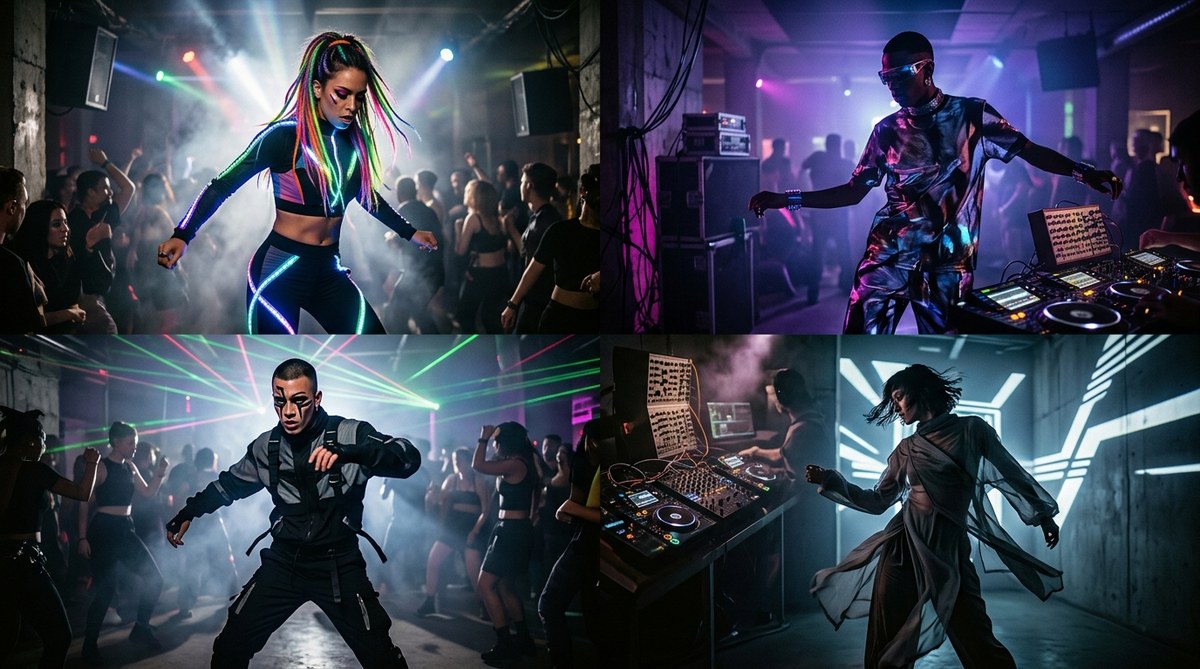
It starts with a hunch. You catch a strange, rolling bassline in a basement set at 3 AM. The crowd is sparse, but the energy is locked in. By the time summer rolls around, that same sound is creeping into daytime festival tents and late-night radio shows. That is exactly where we find ourselves in 2026. The underground dance music landscape is shifting faster than ever, and a handful of microgenres are pulling the strings. If you want to know what will be filling the dance floors in the next twelve months, you need to look past the obvious and focus on the specific, the weird, and the deeply functional.
The four microgenres defining underground dance floors in 2026 are Speed Garage Revival, Weightless Riddim, Neo Trance, and Fractal Techno. Each one borrows from the past but warps the formula with modern production techniques. Understanding their core mechanics will help you book smarter, produce fresher tracks, and keep your sets ahead of the curve.
What Makes a Microgenre Stick in 2026
Mainstream trends move in cycles. Underground microgenres move in spikes. A single track from a small label in Berlin or Bristol can ripple through the community in weeks. The difference in 2026 is the speed of adoption. Social media clips, focused Discord servers, and curated playlists on platforms like SoundCloud have collapsed the timeline from obscurity to ubiquity.
A microgenre needs three things to survive:
- A distinct rhythmic signature that separates it from its parent genre.
- A production aesthetic that is easy to replicate but hard to master.
- A community of DJs and producers who champion it in real-world spaces.
The four genres below check all three boxes. They are not theoretical. They are happening right now on warehouse floors from Los Angeles to London.
Speed Garage Revival
The late 90s UK garage sound never really died, but it spent years in a deep slumber. In 2026, it has woken up with a new pulse. The Speed Garage Revival takes the chopped vocal stabs and shuffle patterns of classic garage and pushes the BPM from 130 to a frantic 145-150. Think of it as 2-step for a generation raised on hard drum and bass.
What sets this revival apart is the production approach. Producers are using modern saturation plugins to push the master bus into a warm, crunchy distortion. The basslines still slide, but they hit harder. The hi-hats are programmed with micro-timing variations that feel almost human.
If you are a DJ looking to mix this into a set, follow these steps:
- Find the vocal intro of your current track and use the high-pass filter to strip the bass.
- Cue the Speed Garage track with its kick drum aligned to the previous track’s offbeat.
- Slam the crossfader during a breakdown section to mask the tempo jump.
- Nudge the pitch control on your CDJ or controller by +3% to lock the new tempo.
- Ride the trim knob to bring the new bassline in slowly over eight bars.
The result is a transition that feels like a gear shift, not a collision. For more on how this fits into broader genre fluidity, check out why genre fluidity is the biggest music trend of 2026.
Weightless Riddim
Weightless Riddim is the sound of negative space. Born from the experimental edges of dubstep and the sparse arrangements of UK bass music, this microgenre strips away everything except the low end and the atmosphere. The kick drum hits once every two bars. The snare is barely a ghost. The sub-bass is the lead instrument.
This music is built for sound systems that can handle extreme low frequencies. It is not for a laptop speaker. It is for a Funktion-One rig in a concrete room where you can feel the pressure change in your chest.
Producers working in this style rely on specific techniques to keep it engaging despite the emptiness:
| Element | Common Mistake | Weightless Riddim Approach |
|---|---|---|
| Sub-bass | Overcompression that kills dynamics | Leave 6 dB of headroom for the sub to breathe |
| Percussion | Filling every 16th note | Use one ghost snare hit per bar for tension |
| Reverb | Short room reverb on everything | Long, modulated hall reverb only on atmospheric pads |
| Arrangement | 32-bar loops with no variation | Introduce a new texture every 16 bars |
The challenge is discipline. It takes confidence to leave space. But when the drop finally arrives after a 64-bar buildup, the crowd reaction is unmatched. If you want to understand how this relates to other low-end heavy styles, read about how jungle and drum and bass are shaping the future of electronic music in 2026.
Neo Trance
Trance music has been through many lives. The 90s brought the epic supersaws. The 2010s brought the big room drop. Neo Trance in 2026 is a different animal. It keeps the BPM around 140 and the arpeggiated synths, but it replaces the euphoric major key melodies with minor chord progressions and dissonant leads.
The kick drum is a techno kick, hard and dry with no tail. The bassline is a distorted square wave that cuts through the mix with aggression. The breakdowns are long and hypnotic, often featuring spoken word samples from obscure sci-fi films.
This is trance for people who say they hate trance. It works because it borrows the structural framework of a familiar genre and subverts the emotional payload. DJs are using Neo Trance tracks as bridges between hard techno and melodic house sets.
“The secret to Neo Trance is the arrangement. You give the listener the build they expect, but you replace the major chord release with a minor seventh. It creates a sense of longing that keeps them on the edge.” – Lina Voss, producer and label head at Submersion Records.
If you are producing Neo Trance, focus on your arpeggiator settings. Use a 16-step pattern with a gate time of 25% to create a staccato feel. Layer that with a saw wave detuned by 12 cents for that signature dissonant shimmer.
Fractal Techno
Fractal Techno is the most cerebral entry on this list. It takes the functional, repetitive nature of classic Detroit techno and fractures the rhythm into irregular time signatures and polyrhythms. A typical track might have a kick drum on every downbeat, but the hi-hat pattern cycles through 7/8 while the bassline loops in 5/4.
It sounds chaotic on paper. In practice, it creates a groove that never quite resolves. The dancer’s brain keeps searching for the one, and the one keeps shifting slightly. This creates a trance-like state on the floor.
Production in Fractal Techno requires a deep understanding of your DAW’s sequencer. You cannot just draw in a four-on-the-floor grid and call it a day. You need to experiment with odd groupings.
- Use a 7/8 hi-hat pattern with accents on beats 1, 3, and 6.
- Layer a 5/4 bassline that restarts on the second bar.
- Keep the kick drum in 4/4 to anchor the groove.
- Add a synth pad that evolves over 16 bars to provide a sense of progression.
The genre is still small, but it is growing fast in cities with strong experimental scenes like Berlin, Detroit, and Tokyo. For producers who want to push their rhythmic skills further, check out mastering drum programming for contemporary music production.
How to Spot the Next Wave Before It Peaks
You now know the four microgenres that are active in 2026. But the nature of underground music is that it keeps moving. The genres that will define 2027 are probably being tested in a small room right now.
Here is a practical checklist for identifying the next microgenre before it hits the mainstream:
- Monitor Bandcamp sales charts for small, niche labels.
- Follow the “New & Notable” section on SoundCloud for tracks with less than 10,000 plays.
- Attend small club nights in cities with strong scenes like Manchester, Montreal, and Melbourne.
- Pay attention to what is being pressed on vinyl. Vinial releases are expensive, so labels only press what they believe in.
- Watch for repeated production techniques across multiple unrelated artists.
If you hear the same weird snare sound or the same unusual bass modulation in three different tracks from three different cities, you have found the seed of a new microgenre. For more on this process, read how to spot the next big genre before it hits the mainstream.
Building Your Sound Around These Genres
You do not have to commit to one microgenre. The best DJs and producers in 2026 are borrowing elements from multiple sources and blending them into a personal style. The Speed Garage Revival gives you energy. Weightless Riddim gives you tension. Neo Trance gives you emotional release. Fractal Techno gives you intellectual depth.
A single set could move through all four of these territories if you sequence it with care. Start with the rhythmic complexity of Fractal Techno to warm up the room. Move into the sparse low end of Weightless Riddim to reset the energy. Build into the melodic dissonance of Neo Trance for the peak time. Close with the relentless shuffle of Speed Garage Revival to send the crowd home sweating.
Keeping Your Finger on the Pulse
The underground dance music world in 2026 rewards curiosity. The moment you stop listening, you fall behind. Make it a habit to spend thirty minutes each week listening to tracks from labels you have never heard of. Set up a private playlist for weird B-sides. Talk to other DJs about what they are hearing in their local scenes.
The four microgenres covered here are not the end of the conversation. They are the starting point. Use them as a lens to listen to the music around you with fresh ears. If you hear something that does not fit into any of these boxes, that is probably the next thing you need to pay attention to. Trust your instincts, keep your ears open, and keep your dance floor moving.
About the Author