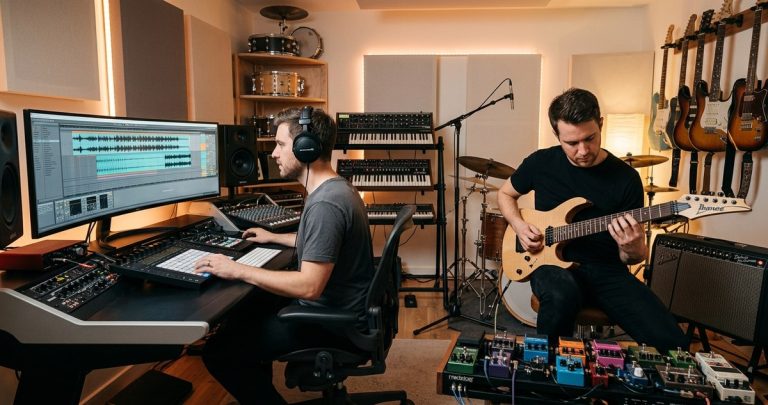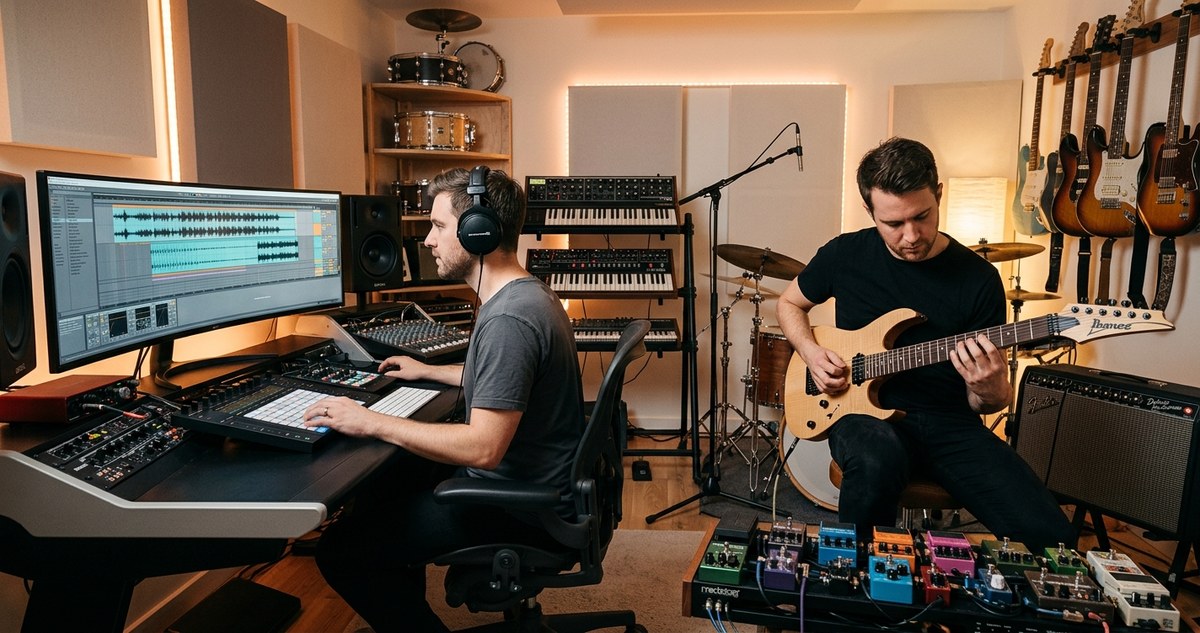
Math rock is the genre that sounds like it’s constantly falling apart and putting itself back together at the same time. For guitarists and producers who feel boxed in by standard 4/4 patterns and predictable chord progressions, this style offers a playground of rhythmic puzzles and textural surprises. It’s not about playing faster. It’s about playing weirder in a way that still feels musical.
If you’ve ever listened to a track by bands like Toe, Chon, or Hella and wondered how they lock into those jagged grooves, you are in the right place. This math rock guide will break down the core techniques, gear choices, and production approaches that define the sound, so you can start writing your own angular riffs today.
Math rock is built on odd time signatures, tapping, and disjointed rhythms that still groove. Success comes from layering contrapuntal guitar lines, programming drums with human feel, and using gear like a compressor and a clean amp. Focus on locking the bass with the kick drum, then build your riffs around rhythmic cycles that repeat but never land where expected.
What Actually Defines Math Rock
People often call math rock “musical gymnastics.” The rhythms shift between 7/8, 11/16, and 5/4 in the same song. Guitarists use two-handed tapping to play melodies and chords at the same time. The bass and drums often play different time signatures against each other, creating a polyrhythmic push and pull.
But here is the secret. Math rock is not cold or robotic. The best math rock bands sound like they are barely holding on. The tension comes from human imperfection. A drummer rushing a fill or a guitarist slightly dragging a pull-off can make the genre feel alive.
If you want to hear the blueprint, check out bands like American Football for the emo-infused side, or Don Caballero for the aggressive, instrumental approach.
The Guitarist’s Toolkit for Math Rock
You do not need a wall of expensive gear to get started. But there are a few essentials that make a real difference.
Tapping and Open String Voicings
The most iconic math rock sound comes from mixing tapped notes with open strings. You play a melody on the higher strings while letting the lower strings ring out. This creates a dense, almost harp-like texture.
Here is a simple exercise to try:
- Tune your guitar to standard or drop D (many players use alternate tunings like FACGCE).
- Pick a shape on the 5th and 6th strings. For example, an Fmaj7 shape.
- Tap a note on the 12th fret of the high E string with your picking hand.
- Let all the other strings ring open.
- Move the shape up two frets and repeat.
This technique is the bread and butter of the genre. Bands like Tera Melos build entire songs around this one idea.
Comping with Syncopation
Your rhythm hand needs to be comfortable with silence. In math rock, the space between notes is just as important as the notes themselves. You will often play short, staccato chords that land on the “and” of a beat, or on the “e” of a sixteenth note.
Try this pattern in 7/8: count 1-2-3-4-5-6-7. Play a muted chord on beats 1, 3, and 6. Then play an open note on beat 5. It will feel wrong at first. That is the point.
Common Techniques and Common Mistakes
| Technique | What It Does | Common Mistake |
|---|---|---|
| Two-handed tapping | Lets you play melody and harmony simultaneously | Tapping too hard; use a light attack to keep clarity |
| Open string drones | Adds harmonic depth without extra notes | Letting open strings ring into key changes; mute them when needed |
| Odd time grooves | Creates rhythmic tension and surprise | Playing the groove too stiffly; add a slight swing or drag |
| Rapid arpeggios | Fills space with cascading notes | Playing too many notes; math rock thrives on selective note choice |
| Syncopated rests | Builds anticipation and energy | Forgetting to count; use a metronome that clicks the 8th note, not the quarter |
“The secret to math rock is that the listener should feel the rhythm change before they understand it intellectually. If you can make someone nod their head and then stop because the beat shifted, you are doing it right.” — Anonymous session guitarist
Producing Math Rock: From DAW to Master
Producers face a different challenge. You are not just playing a part. You are shaping the entire sonic landscape. Math rock demands clarity because the parts are so dense. If your mix is muddy, those intricate guitar lines will turn into noise.
Drum Programming for the Genre
Math rock drums are not about power. They are about precision. The kick and snare often play against the guitar rhythm, not with it.
Here is a step by step process to program a math rock beat:
- Set your time signature. Start with 5/4. Program a kick on beat 1 and beat 3.
- Add a snare on beat 4. This already sounds unusual because the snare is not on 2 and 4.
- Program a hi-hat pattern. Use 8th notes but ghost every third hit. Make it human by shifting the velocity.
- Add a crash cymbal on beat 1 of the second bar. This creates a phrase length of two bars.
- Copy the pattern and change the last beat. On the repeat, move the snare to beat 5 instead of beat 4.
- Humanize the timing. Drag the hi-hat hits by 10 to 20 ticks. Math rock should feel slightly loose.
Bass as a Rhythmic Anchor
In regular rock, the bass follows the guitar. In math rock, the bass often plays a simple, repeating pattern that locks with the kick drum, while the guitar plays complex lines on top. This gives the listener a rhythmic home base.
If you are working with a MIDI bass, use a short, plucked attack. A long sustain will clash with the guitar’s open strings.
Mixing for Clarity
Your mix must have separation. Use a high-pass filter on the guitar tracks at 100 Hz to leave room for the bass. Pan two guitar tracks hard left and right if you have them. Keep the center clear for the kick, snare, and bass.
Compression is your best friend. Use a fast attack and a medium release on the drum bus to glue the odd time signatures together. For the guitars, a slow attack lets the transients pop through, which helps the tapped notes cut through the mix.
Gear That Fits the Genre
You do not need a vintage amp, but certain gear choices make the sound easier to achieve.
- Guitar: A single-coil pickup guitar (like a Fender Stratocaster or a Telecaster) gives you the clarity for tapping. Humbuckers can work, but you will need to roll off some low end.
- Amp: A clean Fender Twin Reverb or a Vox AC30 is the classic choice. You want headroom, not distortion.
- Pedals: A compressor pedal (like a Keeley Compressor) is almost mandatory. It evens out the volume between tapped notes and open strings. A delay pedal with a short, dotted eighth note setting can also add movement.
- DAW Plugins: Use a transient shaper on the drums. A plugin like “Smack Attack” lets you boost the attack of the snare without making it louder overall.
If you are looking for more gear inspiration, check out the top music gear trends every producer should know in 2026 for current recommendations.
Writing Your First Math Rock Riff
Start simple. Do not try to write a 13-minute epic on your first attempt.
- Choose a time signature like 7/8.
- Write a two-note bass pattern. Play the root note on beat 1, then the fifth on beat 4.
- Write a guitar melody that starts on beat 2 and lands on beat 6.
- Repeat the riff but change the last note of the melody.
- Add a drum beat that hits the snare on beat 3 and beat 7.
- Record it and listen back. If it makes you smile, you are on the right track.
Why Math Rock Matters in 2026
The music landscape in 2026 is all about genre blending. Artists are pulling from hyperpop, jazz, and electronic music. Math rock provides a vocabulary of rhythm that fits perfectly into this fluid environment. Producers are starting to use odd time signatures in pop and hip-hop tracks to create hooks that stand out. Guitarists are finding that tapping techniques open up new melodic possibilities that standard strumming cannot reach.
If you want to stay ahead of the curve, understanding math rock is a smart move. It trains your ear to hear rhythm differently. It forces you to think like a composer, not just a player. And it gives you a toolbox of sounds that most musicians never touch.
For more on how genres are shaping the current scene, read about why genre fluidity is the biggest music trend of 2026.
Your Next Step
Grab your guitar or open your DAW. Set a metronome to 7/8 at 120 BPM. Play one note on beat 1, then another note on beat 5. Let that ring. Now add a third note on beat 7. You have just written a math rock riff. Build from there. Record it, loop it, and start layering.
The genre rewards patience and experimentation. You will hit wrong notes. You will lose the beat. That is part of the process. Keep going until the puzzle clicks. When it does, you will have a sound that is entirely your own.
About the Author