Your phone buzzes. A Slack notification slides in. Your email inbox just hit 47 unread. Somewhere down the hall, someone is reheating fish in the microwave. It is 2:47 PM on a Tuesday in 2026, and your brain feels like a browser with 30 tabs open. You are not alone. Focus has become the most valuable resource most of us do not have enough of.
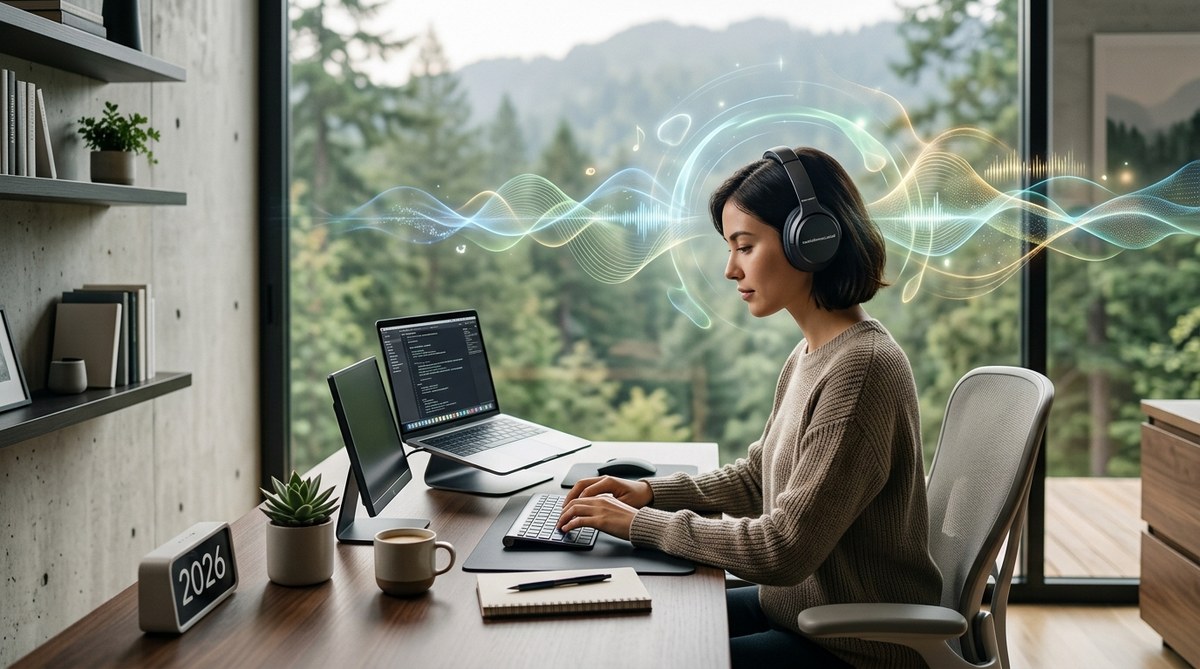
Now imagine this instead. You slip on a pair of comfortable headphones, press play on a track that has no words, no sudden drops, no beat that demands your attention. Just a slow, evolving wash of sound. Within ten minutes, your breathing steadies. Your thoughts stop racing. You look at your task list and actually start working.
That is the quiet power of ambient music. And in 2026, it has become the essential productivity tool for professionals and students who need to protect their attention.
Ambient music provides a science-backed method to improve focus and productivity in 2026. Unlike songs with lyrics or sudden changes, ambient soundscapes create a consistent auditory environment that reduces distractions and calms the mind. This guide explains how to select the right tracks, establish a listening routine, and sidestep common mistakes. Whether studying for exams or working on complex projects, ambient music can sharpen your concentration, helping you get more done with less mental strain.
Why Ambient Music Feels Different from Everything Else
Most music is designed to grab you. A pop song wants your attention on the chorus. A film score wants you to feel tension or triumph. A podcast wants you to follow an argument. All of that is great for entertainment, but terrible for deep work.
Ambient music works the opposite way. It sits in the background on purpose. It does not demand anything from you.
Brian Eno, the artist who basically named the genre, described it as music that is “as ignorable as it is interesting.” That is the whole trick. When a track is interesting enough to keep your brain from getting bored, but ignorable enough that you can focus on a spreadsheet or a textbook, you hit a sweet spot for concentration.
In 2026, when notifications are more aggressive than ever, that kind of auditory environment is a lifeline.
The Science of Steady Sound
Why does ambient music help you focus? It comes down to how your brain processes sound.
Your brain has a builtin alarm system. It is always scanning for changes in your environment. A sudden noise a loud conversation, a car horn, a phone ping triggers a response that pulls your attention away from what you are doing. That is called an orienting response. It is automatic. You cannot control it.
Ambient music reduces the number of those triggers. A long, sustained pad sound or a gentle field recording creates a consistent acoustic environment. Your brain stops waiting for the next surprise. It relaxes its guard.
Research on music and cognition suggests that music with a slow tempo, limited dynamic range, and no lyrics can support tasks that require sustained attention. Ambient music fits all of those criteria. It also helps mask sudden noises from your environment. If a truck rumbles past your window, you might not even notice if a warm ambient drone is playing.
“The best productivity tool is not a new app. It is a sound environment that lets your brain stop being on alert.”
Dr. Maya Chen, cognitive researcher specializing in auditory attention
How to Build Your Ambient Workflow in 2026
Knowing that ambient music helps is one thing. Building it into your actual workday is another. Here is a step by step process that works for most people.
-
Pick a consistent listening method. Use over ear headphones, in ear monitors, or a decent speaker setup. The key is consistency. Your brain will start associating the sound with focus mode. For recommendations on gear, check out the latest top music gear trends every producer should know in 2026.
-
Choose your ambient style. Not all ambient music works the same way. Dark ambient can feel tense for some people. Bright, spacious ambient works better for others. Try three different subgenres over three days and note which one helps you settle into work faster.
-
Set a timer for 50 minutes. Use a focus timer like the Pomodoro technique. Put on your ambient track, set a 50 minute timer, and work without interruption. When the timer goes off, take a 10 minute break in silence. This pattern trains your brain to enter flow state more easily each session.
-
Remove lyrical music from work hours. This is the hardest step for many people. Songs with lyrics activate the language processing centers in your brain. Even if you are not consciously listening, your brain is working to process the words. That competes with reading, writing, and analytical thinking. Save your favorite playlist for breaks.
-
Create a starting ritual. Every time you sit down to work, put on the same ambient album or playlist. Within a few days, the first notes will act as a trigger. Your brain will shift into work mode before you even open your laptop.
Ambient versus Other Focus Music: A Comparison
You might wonder how ambient stacks up against other popular focus genres. Here is a breakdown of how they compare for deep work in 2026.
| Music Type | Best For | Biggest Drawback |
|---|---|---|
| Ambient | Deep focus, reading, writing, coding | Can feel too sparse for some |
| Lo-fi hip hop | Light work, creative brainstorming | Beats can distract during heavy analysis |
| Classical piano | Analytical work, studying | Emotional pieces can pull focus |
| White noise | Blocking distractions, sleeping | No musical interest for longer sessions |
| Nature sounds | Relaxation, light focus | Repetitive loops can become annoying |
| Ambient with field recordings | Deep work with a sense of space | Some recordings include sudden bird calls |
Ambient music sits in a unique spot. It offers enough texture to keep your brain engaged without the rhythmic pull of a beat or the emotional arc of a melody. For tasks that require sustained concentration for an hour or more, it is hard to beat.
Common Mistakes People Make with Ambient Music
Even with the right genre, people sometimes struggle. Here are the most common pitfalls and how to avoid them.
- Choosing tracks that are too dramatic. Some ambient music builds into huge crescendos. That works for a movie scene but not for a Tuesday morning report. Look for music that stays relatively flat in dynamics.
- Listening through laptop speakers. Laptop speakers are tiny and tinny. They emphasize high frequencies and add a layer of digital harshness. Use decent headphones or speakers to get the full benefit.
- Skipping the testing phase. Not all ambient works for all people. If you feel restless or distracted, try a different subgenre. Dark ambient, solar ambient, drone, and space music all feel different.
- Playing ambient too loud. Volume matters. Ambient should sit at a level where it blends with the room. If you can hear every detail clearly, it is too loud. Think of it as audio wallpaper, not a concert.
- Sticking with one album for months. Your brain habituates to sounds. If you hear the same album every day for six months, it becomes invisible. That can be good, but switching between a few trusted albums keeps the effect fresh.
Ambient Subgenres Worth Trying in 2026
The ambient umbrella is huge. If you have only tried one type, you might be missing a style that clicks better with your brain. Here are a few subgenres that are gaining traction this year.
Drone ambient focuses on long, sustained tones with very little movement. It is excellent for deep analytical work. Solar ambient uses warm, bright textures that feel uplifting. It works well for creative tasks and morning sessions. Space ambient uses reverb heavy pads and slow evolution. It creates a sense of vastness that can make your desk feel less confining. For a broader look at what is emerging, check out 5 subgenres that dominate 2026’s music scene.
If you are new to ambient, start with a curated playlist rather than a full album. Many streaming services now have playlists specifically designed for focus and study. Look for ones that mention “deep focus,” “ambient study,” or “soundscapes.”
Setting Up Your Listening Space
Your environment matters as much as the music itself. A few small changes can make ambient music work much better for you.
Place your speakers at ear level if you are not using headphones. If you are using headphones, look for a comfortable pair that does not press too hard. Discomfort will pull your attention faster than any distraction. If you need help choosing, this guide on how to choose the perfect audio tech for your music style covers the key factors.
Keep your listening setup simple. You do not need a high end DAC or expensive cables. A decent pair of wired or wireless headphones and a streaming service are enough. The magic is in the music, not the gear.
Lower the lights a little. A dimmer room helps your brain transition into a calmer state. You are not trying to fall asleep. You are just signaling to your nervous system that it is safe to focus.
Why This Matters More in 2026 than Ever
The world in 2026 is louder and more distracting than it was five years ago. Open office layouts are still common. Remote workers deal with household noise. Students sit in coffee shops with blenders running every two minutes.
Ambient music is not a luxury. It is a practical tool for protecting your cognitive resources. When you control your sound environment, you control your attention. And in a world where every app, every notification, and every algorithm wants a piece of your focus, controlling your attention is the only way to get meaningful work done.
Your First Step Toward Better Focus
You do not need a complex setup or a deep understanding of music theory. You just need a willingness to try something different.
Tomorrow morning, instead of opening your laptop and diving straight into email, put on an ambient track first. Set it at a low volume. Take three deep breaths. Then start your work.
Notice how your mind responds. Notice whether you feel less reactive to the sounds around you. Notice whether you stay with a single task longer than usual.
That is the whole method. It is simple, it is free, and it works. In 2026, ambient music might be the most reliable productivity tool you have. Give it a week, and see what changes.
About the Author