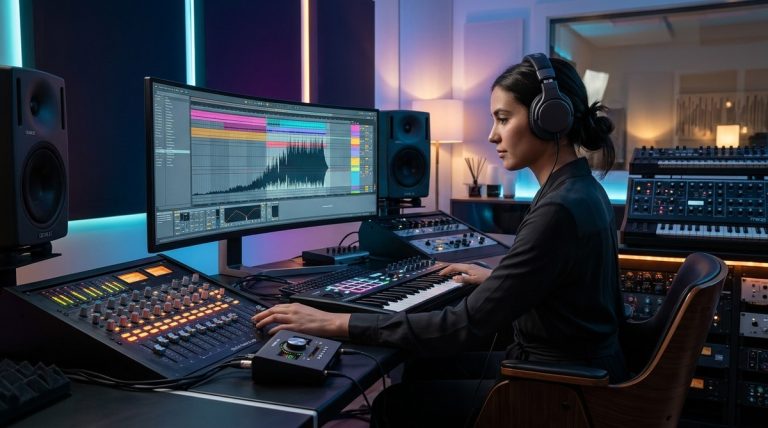
Math rock is a puzzle you get to solve with sound. It rewards the player who can count to seven while feeling a groove in four, and it challenges the listener to stop tapping their foot and start nodding their head in strange, wonderful patterns. In 2026, producing a track that genuinely defies time signatures isn’t just about playing odd meters. It is about using your DAW as a rhythmic laboratory, bending tempo maps, and embracing modern tools that let you warp time without losing the human feel.
To produce a math rock track that defies time signatures in 2026, you need a hybrid approach. Start with a rhythmic skeleton using polyrhythmic MIDI programming, then layer live guitar takes that lock to a shifting tempo map. Use modern Logic Pro and GarageBand features like tempo detection and time signature markers to automate changes. The final mix should use sidechain compression and transient shaping to keep the odd meters punchy and clear, not muddy.
Building the Rhythmic Skeleton in Your DAW
Before you touch a guitar cable, build the drum part. This is the foundation that will either make your odd time signatures feel natural or forced. In 2026, both Logic Pro and GarageBand have improved their time signature automation. You can now draw a tempo map that changes every few bars without glitching.
Start with a simple idea. Write a riff in 7/8 that feels like it wants to shift into 5/4. Do not program the whole song as one long, static meter. Instead, use the DAW’s time signature track to insert a marker at bar 9 that changes the beat structure. Your drum grid will then automatically adjust the bar lines.
A solid workflow looks like this:
- Set your project to a base tempo of 140 BPM in 4/4.
- Program a simple hi-hat pattern on sixteenth notes.
- Insert a time signature marker at bar 5 that changes to 7/8.
- Program a kick drum that accents beats 1, 3, and 6 in that 7/8 section.
- At bar 9, switch to 5/4 and let the snare hit on 2 and 4.
- Use a crossfade on the audio or MIDI clip to smooth the transition.
- Duplicate the section and reverse the order of the meters for a B section.
This method trains your ears to hear the shifts before you even record a single note. It also forces you to commit to the rhythmic architecture early, which saves hours of editing later.
Programming Drums That Breathe Odd Time
Math rock drumming is about contrast. You want the machine gun snare rolls to sit next to wide open hi-hats and ghost notes. In 2026, the best tool for this is a combination of MIDI programming and live velocity editing.
Use a drum sampler like EZDrummer or the built-in Logic Pro drums. Program the kick and snare first. Keep the kick pattern sparse. A common mistake is to overplay the kick drum in odd time, which makes the groove feel cluttered. Let the snare carry the backbeat, even if that backbeat falls on an unusual subdivision.
For ghost notes, go into the piano roll and lower the velocity of every other snare hit to around 30. Then add a second snare sample that is quieter and slightly detuned. Layer these two sounds to get that papery, tight crack that math rock is known for.
Cymbals are where you can really sell the time signature change. Use a crash cymbal to mark the first beat of a new meter. If you are moving from 7/8 to 5/4, crash on the 1 of the new bar and let it ring out over the downbeat. This gives the listener an audio cue that the time has shifted, even if they cannot count it.
Guitar Recording: The Human Glue
Now comes the fun part. Your guitar needs to lock into the programmed drums, but it should not sound robotic. In 2026, the best math rock guitarists use a technique called “rhythmic displacement.” You record a riff in one time signature, then copy the audio file to a track that has a different time signature marker.
For example, record a clean, tapped riff in 4/4. Then drag that audio clip onto a track set to 5/4. The clip will stretch or compress to fit the new bar length. This creates a natural polyrhythm between the original performance and the new time grid. It sounds like two guitarists playing against each other, but it is just you and your DAW.
Here are a few production techniques to try:
- Use a single-coil pickup for the verse riff and a humbucker for the chorus to create tonal contrast.
- Record two takes of the same riff, pan one hard left and the other hard right, then nudge one take by a few milliseconds to create a natural chorus effect.
- Add a clean delay set to a dotted eighth note. Play a riff in 7/8 and let the delay fill the gaps. The delayed notes will land on different beats each bar, creating a constantly shifting texture.
Table: Common Math Rock Production Mistakes and Fixes
| Mistake | Why It Hurts the Track | 2026 Fix |
|---|---|---|
| Over-programming drums | Makes the track feel stiff and lifeless | Use human velocity curves and randomize hi-hat timing by 5% |
| Ignoring tempo mapping | Transitions between time signatures sound abrupt | Draw smooth tempo curves in Logic Pro’s tempo editor |
| Muddy low end | The odd meters lose their punch | Use a multiband compressor on the bass guitar, cutting below 40 Hz |
| Too much reverb | The rhythmic complexity gets washed out | Use a short room reverb (0.4 seconds) on the snare only |
| Quantizing everything | The track loses its human swing | Leave 70% of the guitar takes unquantized; only snap the kick and snare |
The Bass: Locking In Without Locking Down
Bass in math rock is a tightrope walk. You need to follow the guitar riffs, but you also need to anchor the shifting time signatures. The best approach in 2026 is to record the bass after the drums and guitars are placed. This way, you can hear exactly where the rhythmic stress points are.
Play the root notes on the downbeats of each new time signature. If the guitar is playing a fast, angular line in 13/16, the bass should play a simple two-note pattern that repeats every three bars. This creates a counter rhythm that makes the track feel like it is floating above a solid foundation.
Use a compressor with a slow attack and fast release on the bass track. This lets the initial pick attack through while smoothing out the sustain. The result is a punchy, defined bass that cuts through the mix without overpowering the guitar.
Mixing for Clarity in Odd Meters
Mixing a math rock track is different from mixing a standard rock song. The time signature changes mean that the listener’s ear is already working hard to follow the rhythm. Your mix should not add to that mental load.
Start with the snare drum. The snare is the most important rhythmic marker in odd time. Make it cut through the mix by boosting around 200 Hz for body and 5 kHz for snap. Use a gate to tighten the snare decay so it does not bleed into the next beat.
The guitar tones should be dry. Use a noise gate on the guitar tracks to eliminate string noise between riffs. This is crucial in math rock because the rests between notes are part of the rhythm. If the guitar is buzzing or humming during a rest, the time signature shift loses its impact.
Pan the rhythm guitar slightly left and the lead guitar slightly right. Keep the bass and kick drum centered. This creates a stereo image that feels wide but has a solid, mono low end.
“The secret to mixing math rock is to treat every time signature change like a new song. Adjust your fader levels for each section. The verse in 7/8 might need more bass, while the chorus in 5/4 might need more guitar presence. Do not be afraid to automate everything.” – Veteran producer and session guitarist for a well-known math rock band.
Using Sidechain Compression for Rhythmic Emphasis
Sidechain compression is not just for electronic music. In math rock, you can use it to make the rhythm section breathe with the odd time signatures. Route the kick drum to a compressor on the bass track. Set the threshold so that every time the kick hits, the bass dips slightly in volume.
This creates a pumping effect that reinforces the kick pattern. If your kick is playing a syncopated rhythm in 9/8, the bass will duck and swell in sync with that pattern. The listener will feel the odd time signature in their chest, not just in their head.
You can also sidechain the rhythm guitar to the snare. Every time the snare hits, the guitar ducks by 1 dB. This gives the snare more space without having to raise its volume. It is a subtle effect, but it makes a huge difference in a dense mix.
Practical Workflow for a 2026 Math Rock Track
Here is a step-by-step process you can follow right now in Logic Pro or GarageBand:
- Create a new project at 140 BPM in 4/4.
- Program a basic drum pattern with kick on 1 and 3, snare on 2 and 4.
- Insert time signature markers to change the meter every 8 bars (4/4, 7/8, 5/4, 9/8).
- Record a scratch guitar track playing a simple melody in 4/4.
- Drag the scratch guitar audio to the 7/8 section and let the DAW stretch it.
- Adjust the stretched audio to fit the new bar lines by editing the audio regions.
- Program the drums to match the new guitar rhythm.
- Record the final guitar takes using a metronome that follows the time signature markers.
- Record the bass, locking into the kick drum pattern.
- Mix with a focus on snare clarity and low-end control.
This workflow takes about three to four hours for an experienced producer. The result is a track that sounds like it was written by a band that has been playing together for years, but it was all done in your bedroom studio.
Why Genre Fluidity Matters in 2026
Math rock has always borrowed from other genres. In 2026, the lines between math rock, progressive metal, and even lo-fi hip-hop are blurring. Producers are using odd time signatures in pop songs and trap beats. This means that the techniques you learn for math rock can be applied to almost any genre.
If you want to stay ahead of the curve, study how modern technology is transforming music styles. The same tempo mapping tricks you use for a 13/16 riff can be used to make a hip-hop beat feel off-kilter and interesting. The same sidechain compression that makes your math rock snare pop can give a lo-fi track that wobbly, tape-like feel.
Check out our guide on the art of genre blending to see how these techniques translate across styles.
Final Thoughts on Building Your Odd-Time Workflow
The goal is not to write a track that is impossible to count. The goal is to write a track that feels natural even though it is mathematically complex. In 2026, the tools are better than ever. You can automate time signature changes with a few clicks, you can stretch audio without artifacts, and you can sidechain compress with surgical precision.
But the human element still matters. The slight imperfections in your guitar timing, the ghost notes that barely register, the cymbal crash that rings a little too long. Those are the things that make math rock feel alive.
So open your DAW, set a weird time signature, and start programming. Let the meter shift every few bars. Record a riff that fights the grid. Then let the grid fight back. That tension is where the magic lives.
About the Author