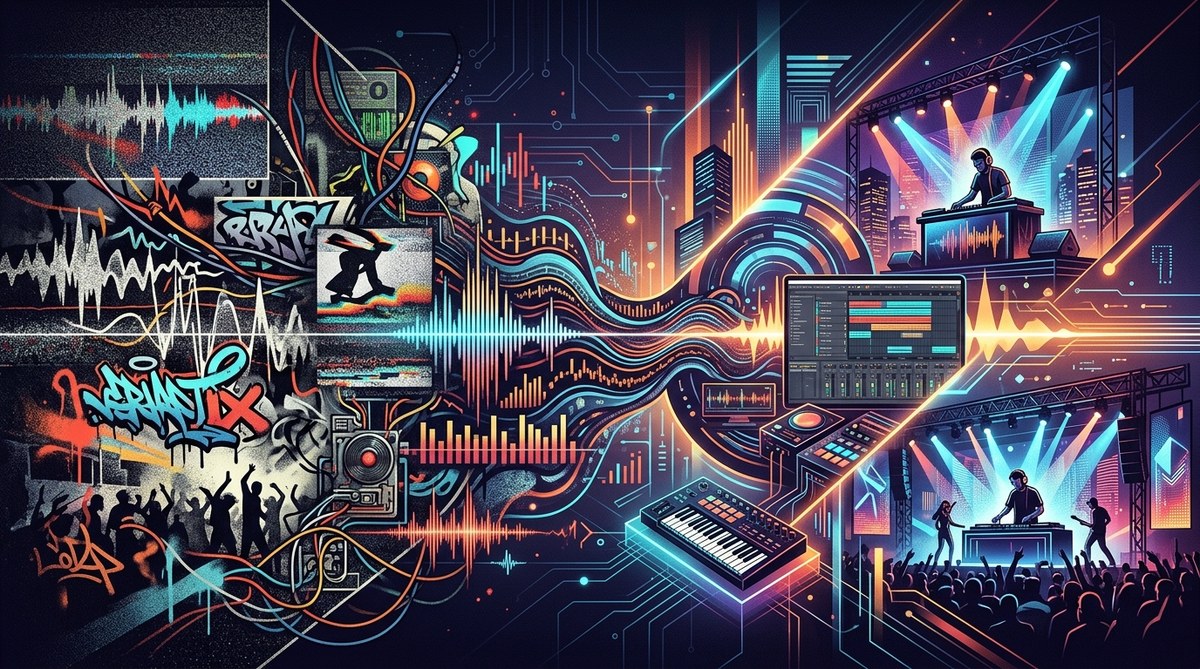
The sound of a thousand chopped drums firing at once used to mean one thing: a niche genre played only in sweaty basement clubs. Today, those same frantic breakbeats show up in Billboard hits, TikTok viral sounds, and top-tier film scores. Breakcore didn’t just escape the underground. It reprogrammed the way modern producers think about rhythm, texture, and chaos. To understand how we got here, you have to trace the full breakcore history from its roots in early rave culture to its quiet takeover of mainstream production in 2026.
Breakcore emerged from the collision of hardcore rave, jungle, and digital experimentation in the mid-1990s. It thrived on internet communities and netlabels, evolving through extreme tempo shifts and chaotic sampling. By 2026, its techniques influence pop, hyperpop, and film scoring. Producers who study breakcore history gain a powerful toolkit for rhythm, texture, and emotional tension.
From Rave Culture to Bedroom Studios
Breakcore didn’t appear in a vacuum. The early 1990s saw hardcore techno and jungle explode across the UK and Europe. Rave promoters pushed tempos higher, and producers began hacking apart drum breaks from classic funk records. Amen breaks, think breaks, and hot pants became raw material. By 1994, a subculture of producers was already warping these loops into something more chaotic.
The term “breakcore” started to stick around 1997 thanks to online forums on IRC and early message boards. Artists like Venetian Snares, DJ Scud, and Enduser took the aggressive energy of hardcore and added layers of cut-up samples, glitchy edits, and sudden tempo shifts. Unlike jungle, which still clung to a steady groove, breakcore actively destroyed the groove and rebuilt it every few bars. It was music for people who wanted to feel unsettled in the best way.
Home computers became central to this sound. While earlier rave producers relied on hardware samplers and heavy gear, breakcore artists could achieve extreme editing with free software like ModPlug Tracker and later Renoise. This lowered the barrier to entry. Anyone with a PC and an internet connection could make breakcore. That DIY spirit fueled the genre’s rapid evolution and kept it weird.
The DIY Ethos and the Internet Underground
The early 2000s were a golden age for breakcore’s underground scene. Netlabels like Mirex, Peace Off, and Ad Noiseam distributed music for free or on cheap CD-Rs. File-sharing platforms like Soulseek and early blogs let fans trade tracks across continents. For a producer in rural Iowa, discovering Venetian Snares or Bong-Ra felt like finding a secret world.
What made breakcore different from other electronic genres was its complete disregard for commercial appeal. Tempo could jump from 160 BPM to 300 BPM in a single transition. Melodies appeared and vanished. Samples ranged from cartoon sound effects to political speeches. The genre embraced maximalism and absurdity. Yet within this chaos, a strict set of production techniques emerged.
Numbered List: Three Core Breakcore Production Steps
- Chop the break into micro-segments. Use a DAW or tracker to slice a drum loop into 16th or 32nd note pieces. Rearrange them randomly or in a pattern that contradicts the original rhythm.
- Layer multiple breaks at different tempos. Warp an amen break at 170 BPM and layer a second break at 200 BPM with time-stretching. The resulting polyrhythm creates a disorienting but energetic core.
- Add sudden tempo shifts and sample stabs. Map tempo automation to dramatic jumps (e.g., 140 to 280 BPM in one bar). Insert short vocal samples or sound effects on off-beats to keep listeners guessing.
These steps might sound chaotic, but they require precise timing and ear training. Many producers fail when they try to make breakcore without understanding the rhythmic foundation. The best tracks still have a hidden logic even at their most manic.
The Sound of Chaos: Techniques and Common Pitfalls
A breakcore producer’s skill is measured by how well they control the mess. Too much randomness sounds like noise. Too little sounds like generic drum and bass. Below is a table that breaks down common techniques versus frequent mistakes.
| Technique | Common Mistake |
|---|---|
| Chopping breaks at transient points | Chopping at random zero-crossings, creating clicks and pops |
| Using sidechain compression on bass to follow fast kicks | Applying compression globally, flattening the dynamics of the break |
| Adding a melodic pad or drone for contrast | Overloading the track with too many competing samples, causing listener fatigue |
| Employing sudden silence or half-time sections | Failing to signal the change, leaving the audience lost |
| Pitch-shifting samples for texture | Over-pitching to the point of distortion that hurts the ears |
The goal is to create tension and release. A good breakcore track builds energy, then drops into a sparse section, then explodes again. Producers who master this ebb and flow can apply the same principles to any genre.
From Niche to Mainstream: Breakcore in Pop and Film
By the late 2010s, breakcore’s DNA started leaking into wider music culture. Pop producers began borrowing the chopped amen break technique for transitions in songs by artists like Charli XCX, Dorian Electra, and 100 gecs. The rise of hyperpop in the early 2020s directly borrowed breakcore’s maximalism, glitch editing, and genre-splicing. In 2026, you can hear breakcore influences in everything from trap hi-hat patterns to cinematic action sequences.
Film composers also took notice. The brutal sound design of movies like “The Substance” (2024) and certain episodes of “Black Mirror” use breakcore-style percussive edits to heighten anxiety. Even video game soundtracks, particularly in indie titles like “Cruelty Squad” and “Neon White,” rely on breakcore’s rhythmic unpredictability.
This path from niche to mainstream is not unique to breakcore. Other genres have followed similar trajectories. For example, the rise of lo-fi music also started in bedrooms and ended up on massive playlists. Producers who study these patterns can better predict what might break out next. Read more about that journey in our article on the rise of lo-fi music and its impact on modern production.
And if you are curious about how hyperpop continues to evolve alongside breakcore, check out our piece on why hyperpop is the most influential genre you haven’t heard of yet.
Why Producers Should Study Breakcore in 2026
Studying breakcore history is not just trivia. It gives you a direct pipeline to unconventional rhythm and texture that can set your music apart. The genre teaches you to think in terms of cutting, rearranging, and recontextualizing. These skills are directly transferable to trap, house, and even ambient music.
“The biggest lesson breakcore taught me is that you can break any rule as long as you understand why the rule exists first. Once you know how to program a steady beat, you can program a broken one that still feels intentional.” — Anonymous producer from the Mirex netlabel era
That quote sums up the mindset. In 2026, with AI tools and infinite sample libraries, the ability to create intentional chaos is more valuable than ever. Many producers fall into the trap of making music that sounds clean but lacks personality. Breakcore forces you to embrace imperfection and surprise.
If you are working on trap or hip-hop tracks, try applying breakcore’s layering techniques to your hi-hats and snares. Our guide on top techniques for producing trap and hip-hop tracks offers a practical starting point for blending these ideas.
The Future of Breakcore in 2026 and Beyond
Breakcore is no longer a closed club. Major streaming platforms now host dedicated playlists for “breakcore” and “digital hardcore.” Producers like Machine Girl, goreshit, and Xanu have millions of plays. But the genre still retains its core identity. It remains a testing ground for extreme production ideas that later filter into the mainstream.
In 2026, we see two dominant trends. First, breakcore is fusing with other genres even more aggressively. Artists are mixing breakcore with synthwave, dubstep, and even regional styles like amapiano. The result is a constantly mutating sound that defies categorization. Second, live breakcore performances are becoming more common, with artists using controllers and laptops to trigger chopped breaks in real time. This brings the chaotic energy of the 90s raves into modern festival settings.
For producers, the takeaway is clear: breakcore history is not a museum piece. It is a living toolkit. Whether you want to add tension to a film score or shock listeners in a club, the techniques born from this genre are ready to use.
Next time you sit down at your DAW, try chopping one drum loop beyond recognition. Experiment with a tempo jump. Add a sample that makes no sense. You might just stumble on a sound that defines the next wave of music.
And if you want to stay ahead of the curve, keep an eye on how to identify the next breakout genre before it goes mainstream. Breakcore proved that the underground always has something to teach the mainstream.
About the Author
