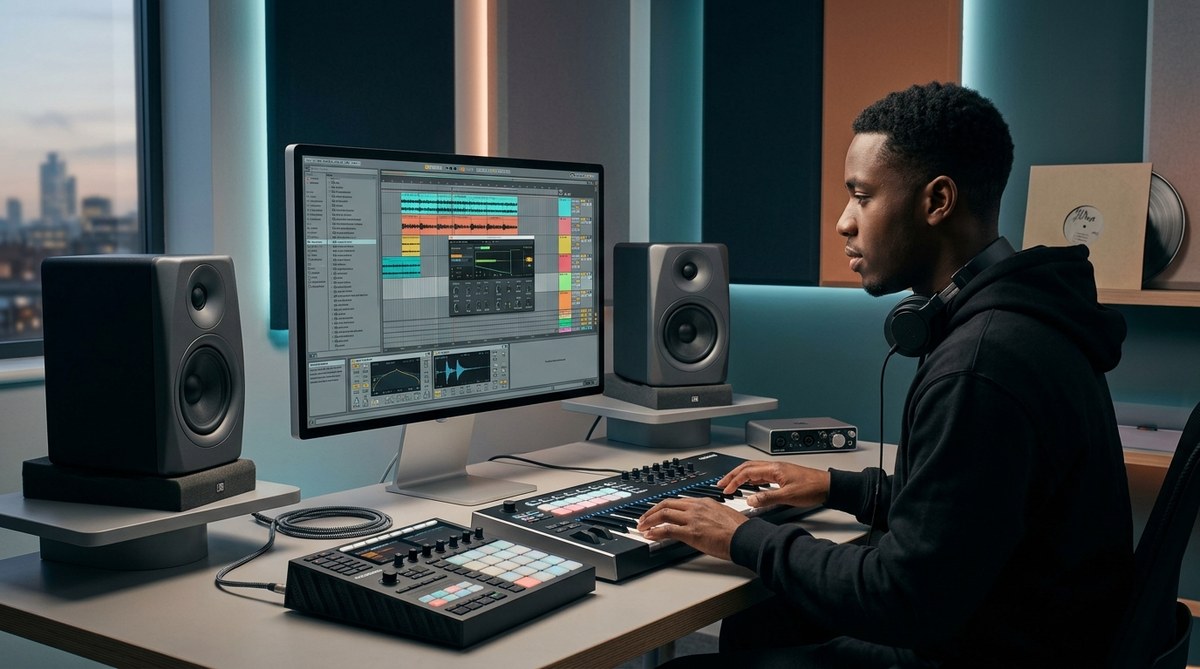
Making a UK garage beat that sounds authentic in 2026 is harder than it looks. The genre has a specific feel that sits between the four-on-the-floor rigidity of house and the half-time swagger of hip-hop. Too much swing and it falls apart. Too little and it sounds like a stiff house track with the wrong samples. I have spent years trying to nail this sound in my bedroom studio, and I have learned that the secret is not in the gear. It is in the shuffle.
To produce authentic UK garage in 2026, focus on three pillars: a swung 2-step drum pattern with a ghost note snare, a subby Reese bassline that moves in call-and-response with the kick, and a filtered vocal chop or pad that creates space. Use modern plugins like ShaperBox for sidechain and RC-20 for grit, but keep the arrangement sparse. Less is more in garage.
What Makes UK Garage Different in 2026
UK garage has evolved. The classic late-90s sound from artists like MJ Cole and Artful Dodger still forms the backbone, but modern producers like Conducta, Oppidan, and Sammy Virji have pushed the genre into new territory. In 2026, your UK garage beat tutorial needs to account for both the vintage warmth and the modern clarity that streaming platforms demand.
The core DNA remains the same:
– A shuffled 2-step kick pattern (kick on beat 1, skip beat 2, kick on beat 3, skip beat 4)
– A snare or clap on beats 2 and 4, often with a ghost note in between
– A subby bassline that syncopates against the kick
– Sparse, atmospheric pads or vocal chops
– Heavy use of sidechain compression to create that breathing, pumping feel
Your 5-Step Workflow for a Garage Beat
Here is a practical process I use every time I start a garage track. Open your DAW, set the tempo between 128 and 135 BPM, and follow these steps.
-
Program the drums first. Start with the kick. Place it on beat 1 and beat 3 of every bar. That is your foundation. Now add the snare on beats 2 and 4. The magic happens when you add a ghost snare on the off-beat sixteenth note right before beat 2. This creates the shuffle. Use a classic 909 snare layered with a rim shot for that punchy attack.
-
Apply swing to the hi-hats. Garage hi-hats are not straight. Set your DAW’s swing parameter to around 55-65 percent. Program a closed hat on every sixteenth note, then remove a few hits to create a lopsided pattern. Open the hi-hat on beat 2 and beat 4 for accent. In 2026, I use the MPC swing templates in Ableton or the groove pool in FL Studio.
-
Write the bassline. The bass should mirror the kick rhythm but not play the exact same notes. Use a Reese-style patch with two detuned saw waves. Play a root note on beat 1, then a fifth or seventh on the off-beat after beat 2. This call-and-response motion is what makes garage feel like a conversation between the kick and the bass.
-
Add the vocal or pad element. Find a short vocal clip or a sustained pad. Filter it with a low-pass filter around 400 Hz. Apply a heavy sidechain from the kick drum so the vocal ducks out of the way on every kick hit. This creates that classic garage pumping effect. In 2026, plugins like Kickstart 2 or ShaperBox make this step effortless.
-
Mix with space in mind. Garage is not a loud genre. Leave headroom. Keep the kick hitting at -6 dB and the snare at -9 dB. The bass should sit just below the kick in volume. Use a gentle reverb on the snare to give it a roomy feel, but keep the decay short around 0.6 seconds.
Drum Programming: The Make-or-Break Element
The drums are the most important part of any UK garage beat tutorial. If your drums do not swing, the track will not work. Here is a table that compares common mistakes with the correct approach.
| Common Mistake | Why It Fails | Correct Approach |
|---|---|---|
| Straight 16th-note hi-hats | Removes the shuffle feel | Apply 55-65% swing, delete some hits |
| Snare on every beat | Makes it sound like house | Snare only on beats 2 and 4 |
| No ghost notes | Pattern sounds robotic | Add a ghost snare on the 16th before beat 2 |
| Kick on every beat | Kills the 2-step rhythm | Kick on beat 1 and beat 3 only |
| No sidechain compression | Drums and bass clash | Sidechain bass and pads to the kick |
Choosing the Right Sounds for 2026
Your sample selection matters more than your mixing skills. In 2026, producers have access to incredible sample packs that capture the vintage hardware sound. Look for these specific elements:
-
Kicks: A short, punchy kick with a clicky attack. Avoid long boomy kicks. The kick should be around 100 ms in length. Think of the kick in “Flowers” by Sweet Female Attitude.
-
Snares: A tight 909 snare layered with a clap. The snare should have a snap, not a ring. Tune it to the root note of your track.
-
Bass: Use a Reese patch from Serum or Vital. Detune two saw waves by about 12 cents. Add a low-pass filter around 200 Hz and automate the cutoff for movement.
-
Pads: Wurlitzer or Rhodes electric piano samples work perfectly. Add a low-pass filter and heavy reverb. Keep them in the background.
“The best garage tracks sound like they are about to fall apart, but they never do. That tension between chaos and control is what makes the genre addictive.” — Conducta, in a 2025 interview for MusicTech
Common Production Traps to Avoid
I have ruined more garage beats than I care to admit. Here are the traps that still catch me.
Overcomplicating the arrangement. Garage is a DJ genre. DJs want tracks that are easy to mix. Keep your intro to 16 or 32 bars with just the drums and a filtered pad. Drop the bass at the 32-bar mark. Bring in the vocal at bar 48. Do not add a new element every 8 bars.
Using too much reverb. Garage needs dry drums. If your snare has a 2-second reverb tail, it will smear the rhythm. Use a room reverb with a decay of 0.4 to 0.6 seconds. Keep the mix below 30 percent.
Ignoring the sub frequencies. Garage basslines often play in the same range as the kick (40-100 Hz). Use a spectrum analyzer to check for mud. If the kick and bass are fighting, sidechain the bass or use a dynamic EQ to cut the bass at the kick’s fundamental frequency.
Forgetting the vocal chop. Garage without vocals feels empty. Even a simple “yeah” or “uh” chopped and pitched up can add character. Process the vocal with a bit of distortion and a fast delay. In 2026, I use Baby Audio’s Transit for this.
Modern Plugins That Make Garage Production Easier
You do not need expensive hardware to make authentic UK garage in 2026. These plugins handle the heavy lifting.
- ShaperBox 3 for multi-band sidechain and volume shaping
- RC-20 Retro Color for lo-fi warmth and vinyl crackle
- Serum or Vital for Reese bass patches
- Kickstart 2 for instant sidechain ducking
- Valhalla Supermassive for huge, washed-out reverb on pads
Putting It All Together: A Sample Arrangement
Here is a simple arrangement structure you can copy for your next track.
- Intro (0:00-0:32): Kick and hi-hats only. Filtered low. Add a snare at bar 16.
- Build (0:32-1:00): Bring in the bassline. Add a filtered pad. Sidechain everything to the kick.
- Drop (1:00-1:30): Full drums. Vocal chop enters. Snare hits harder.
- Break (1:30-2:00): Remove the kick. Keep the pad and vocal. Add a riser.
- Second drop (2:00-2:30): Bring back everything. Add a second bass layer for variation.
- Outro (2:30-3:00): Filter out the bass. Fade the drums.
How to Know When Your Beat Is Ready
Play your track on a pair of laptop speakers or a phone speaker. If the kick and snare cut through and the bass is still audible, you are in good shape. Then play it in a car. If the subwoofer makes the rearview mirror shake, you nailed the bass. If neither works, go back and check your levels.
The best test is to play it for a friend who does not produce music. If they start bobbing their head, you have captured the garage feel. If they ask what genre it is, you might be overthinking it.
Staying Inspired in 2026
The UK garage scene is alive and well in 2026. Labels like Local Action, Time Is Now, and Garage Shared are releasing fresh tracks every week. Listen to what they are doing. Pay attention to how modern producers blend garage with other genres like amapiano, jungle, and even house. The genre is not stuck in the past. It is moving forward.
For more genre inspiration, check out our guide on why genre fluidity is the biggest music trend of 2026. You might also find value in mastering drum programming for contemporary music production to strengthen your rhythm skills.
Your Next Step as a Garage Producer
Open your DAW right now. Set the tempo to 130 BPM. Load a kick sample that is short and punchy. Program it on beat 1 and beat 3. Add a snare on beats 2 and 4. Now add a ghost snare on the sixteenth note before beat 2. Listen to that shuffle. That is the sound of UK garage. From there, everything else falls into place. Trust your ears, keep it simple, and let the swing do the work.
About the Author
