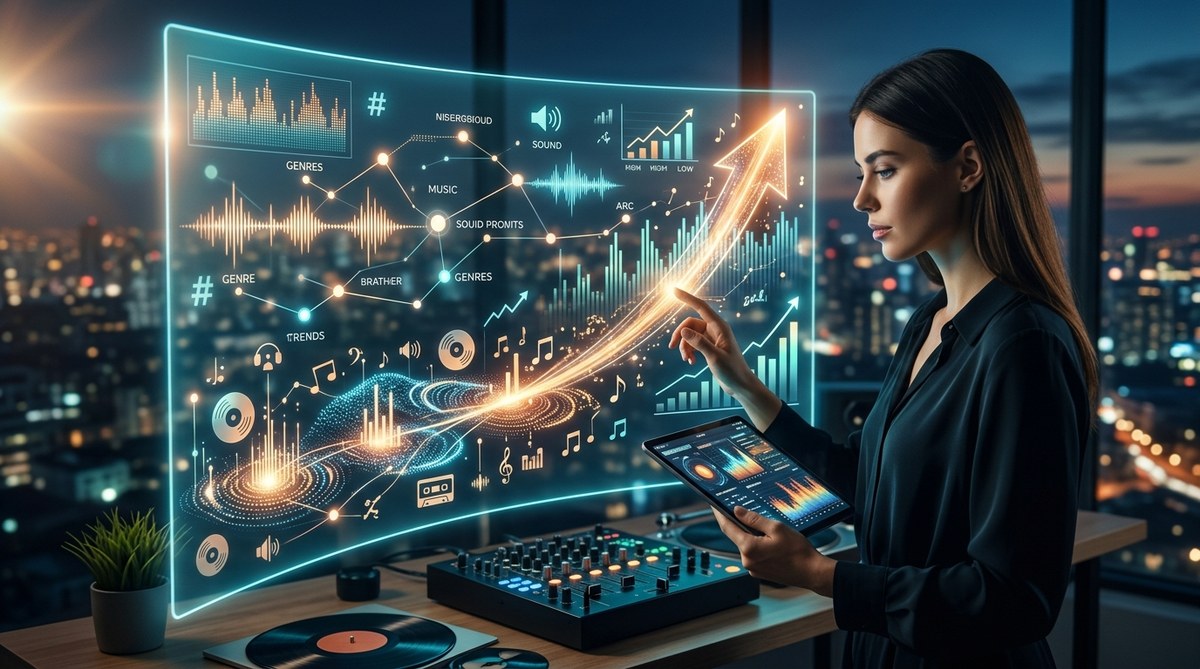
You are scrolling through TikTok and a beat catches your ear. It sounds like lo-fi, but the drums hit harder. The bassline feels familiar, yet the tempo is different. You check the comments. Nobody has a name for it yet. That moment, right there, is where you want to live. Being early on a sound is the difference between chasing a trend and setting one. The music industry moves fast, but the signals are always there if you know where to look. Learning how to predict music trends is not about guessing. It is about reading the room before the room gets crowded.
Predicting music trends comes down to three things: watching underground scenes, tracking production data, and understanding cultural shifts. This guide gives you a repeatable system to spot emerging genres early. You will learn which platforms to monitor, what production patterns to look for, and how to separate a fad from a real movement. By the end, you will have a practical toolkit to stay ahead of the curve in 2026 and beyond.
The Three Signals That Always Arrive First
Every major genre shift starts with the same three signals. They appear in a specific order. If you catch the first one, you have a head start of six to twelve months.
Signal 1: The Niche Community Explosion
A new sound never starts on the radio. It starts in a Discord server, a Reddit thread, or a small SoundCloud circle. Look for communities where people share tracks that do not fit existing categories. When members start making up names for the sound (like “glitch soul” or “desert trap”), that is your first clue.
Signal 2: The Production Shortcut
Every emerging genre relies on a specific production technique that becomes easier to replicate. Think of the 808 slide in trap, the sidechain compression in house, or the granular synthesis in ambient music. When a new plugin, a free sample pack, or a YouTube tutorial makes a technique accessible, the genre spreads fast.
Signal 3: The Cultural Anchor
A genre sticks when it connects to something bigger than music. It might be a fashion trend, a social movement, or a shift in how people work. Lo-fi hip hop blew up because it became the soundtrack for studying and working from home. Drill music grew because it spoke to a specific urban experience. The cultural anchor gives the genre staying power.
How to Build Your Trend Radar
Set up a simple monitoring system. You do not need expensive tools. You need consistency.
- Follow genre-agnostic curators on YouTube and TikTok. These are accounts that post “weird finds” or “unreleased gems.” They do not care about labels.
- Watch the sample flip community. When producers start sampling the same obscure record from the 1970s or a specific field recording, a trend is brewing.
- Monitor Bandcamp daily. Sort by “new and notable” in the electronic and experimental sections. Read the tags that artists choose for themselves.
- Pay attention to genre tag collisions. When you see “footwork + jazz” or “drill + reggaeton” in the same description, a hybrid is forming.
- Check Spotify’s “Fans Also Like” for small artists. The recommendations reveal which micro-scenes are cross-pollinating.
The 5-Step Process for Spotting a Genre Early
Here is a repeatable workflow you can run every month.
-
Scan the underground uploads. Spend 30 minutes on SoundCloud, Bandcamp, and YouTube. Look for tracks with fewer than 5,000 plays that have a unique combination of production elements. Write down the tags and descriptions.
-
Identify the production pattern. Ask yourself: what is the one sound that defines this track? Is it a specific drum sample? A vocal effect? A chord progression? If you can name the technique, you can track its spread.
-
Track the repetition. Search for that same technique on other platforms. If you find it in five different tracks from five different producers within two weeks, you have a pattern.
-
Check the gear and plugin forums. Visit r/edmproduction or Gearspace. Look for threads asking “how do I make this sound?” If people are trying to replicate it, the genre is gaining momentum.
-
Watch the remix response. When established producers start remixing the original tracks from the underground scene, the genre is about to break. Remixes are the bridge between niche and mainstream.
Common Mistakes That Kill Your Timing
Even experienced producers miss trends because they fall into predictable traps. Here is a table of the most common mistakes and how to avoid them.
| Mistake | Why It Happens | The Fix |
|---|---|---|
| Ignoring non-English scenes | Western bias in music discovery | Search for playlists from Nigeria, Japan, Brazil, and South Korea weekly |
| Waiting for a genre name | Labels appear late in the cycle | Focus on production elements, not category names |
| Dismissing “bad” production | Lo-fi and raw sounds often start trends | Listen for intention, not polish |
| Only watching major platforms | Real trends start on Discord, Telegram, and private groups | Join three niche music communities this month |
| Chasing every micro-trend | FOMO leads to wasted time | Apply the 2-week rule: if the sound is still growing after 14 days, invest attention |
What the Data Tells Us About 2026
The numbers from early 2026 already point to a few clear directions. Streaming data from Q1 shows that genre-blending tracks are growing 40 percent faster than single-genre tracks. Producers who combine three or more influences are seeing higher playlist adds. The most shared tracks on social media right now mix elements from UK garage, West African highlife, and hyperpop vocal chops.
“The next big genre will not be a new sound. It will be a new combination of sounds that already exist. Your job is to catch the combination before it gets a name.” — industry analyst quoted in a 2026 Music Trends Report
This is why learning how to predict music trends requires a global ear. The most exciting hybrid happening right now is the fusion of Amapiano log drums with Detroit techno basslines. It is showing up in small clubs in London and on TikTok edits from Lagos. Nobody has named it yet. That is the window.
Tools That Help You See the Future
You do not need a crystal ball. You need the right tools and a system.
- Chartmetric for tracking artist growth and playlist additions across platforms.
- Every Noise at Once for visualizing genre maps and spotting new micro-genres as they appear.
- SoundCloud’s repost graph for seeing which underground tracks are being reshared by influential DJs.
- TikTok’s sound analytics for monitoring how quickly a specific audio clip is being used in new videos.
- Spotify’s “Discovery Mode” playlists for finding tracks that are being algorithmically tested on new audiences.
Set a weekly reminder to check these sources. Consistency beats intensity.
Your Action Plan for This Week
You can start spotting the next big genre today. Here is a simple weekly routine.
- Monday: Scan Bandcamp’s electronic and experimental sections. Pick three tracks under 1,000 plays.
- Tuesday: Search for the production technique from one of those tracks on YouTube. Watch a tutorial if it exists.
- Wednesday: Join a niche music Discord server. Introduce yourself and ask what people are listening to.
- Thursday: Check TikTok’s sound page. Look for audio clips that are being used in unexpected contexts.
- Friday: Write down one trend you noticed. Share it with a friend or post it in a music production group.
How to Build Your Own Sound From a Trend
Spotting a trend is useful. Using it to make your own music is powerful. When you identify an emerging genre, do not copy it. Borrow one element. Maybe it is the drum pattern. Maybe it is the vocal processing. Add it to your existing style. That is how genre fluidity works in 2026. You can read more about why genre fluidity is the biggest music trend of 2026 to understand how artists are blending influences without losing identity.
The same approach applies to production gear. As new genres emerge, they often require specific tools. If you are interested in the hardware side of trendspotting, check out the top music gear trends every producer should know in 2026. The right synth or drum machine can put you ahead of the curve.
Seeing the Signal Through the Noise
The hardest part of learning how to predict music trends is ignoring the noise. Most of what you hear on the radio today was already being discussed in underground forums two years ago. The trick is to stop looking for the finished product and start looking for the raw ingredients. A new drum sample. A vocal effect that sounds wrong but feels right. A tempo that sits between two established genres.
When you train your ear to hear these fragments, the future of music becomes visible. You will hear the next wave before it crashes. And when it does, you will already have your own version ready.
Start this week. Pick one platform you have not checked in a while and spend ten minutes listening to something unfamiliar. That ten minutes might be where you hear the next big thing.
About the Author
