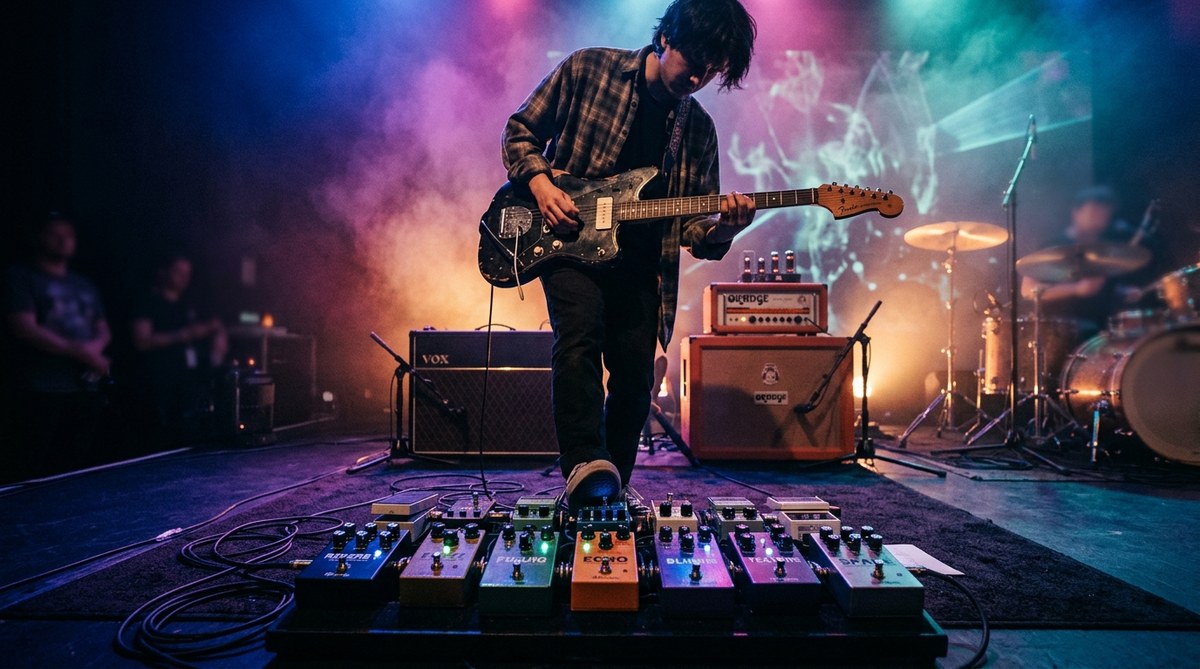
The sound of a guitar through a cranked amp, drenched in reverb until the notes blur into a warm haze. That feeling of being swallowed by sound, where melody and noise become one. For years, that feeling belonged to a small but devoted community. Now, in 2026, the shoegaze revival is rewriting the rules of indie music. Bands are selling out clubs from Brooklyn to Los Angeles. TikTok clips of wall-of-sound riffs rack up millions of plays. And a new generation of producers is blending the genre’s signature textures with modern production tricks. This isn’t a nostalgia trip. It’s a full-blown creative movement.
The shoegaze revival 2026 is driven by seven core techniques: layered reverse reverb, analog tape emulation, drum bus compression, sub-bass integration, AI-assisted mixing, intentional lo-fi artifacts, and genre-blending with hyperpop and slowcore. Master these, and you can create the immersive, forward-looking sound that defines today’s indie scene.
The Seven Techniques Defining the 2026 Sound
Every track that captures the current moment shares a few DNA strands. These seven techniques are the building blocks. They are not rigid rules. Think of them as tools you can reach for when you want to build a wall of sound that feels both classic and completely new.
1. Layered Reverse Reverb with Forward Decay
The old trick was simple: reverse a reverb tail, bounce it, and flip it back. The 2026 version is more surgical. Producers now layer three or four separate reverb sends on a single guitar track. Each send has a different pre-delay and a different decay time. One might be a shimmer hall. Another might be a gated plate. The result is a texture that breathes and shifts instead of just smearing everything together.
How to set it up in your DAW:
- Send your dry guitar signal to a bus with a high-quality reverb (Valhalla, Eventide, or a good convolution reverb).
- Set the mix to 100% wet and bounce the audio.
- Reverse the bounced audio file.
- Place the reversed file on a new track, aligned so the peak hits just before the original dry note.
- Add a second reverb send on the dry track with a short, tight decay (around 1.2 seconds) to fill the space after the attack.
- Blend to taste. Start with the reversed layer at -10 dB relative to the dry signal.
2. Analog Tape Emulation on the Master Bus
The 2026 shoegaze revival craves warmth. Digital perfection sounds sterile for this genre. The solution is subtle tape emulation across the entire mix. Plugins like Waves J37 or UAD Studer do the job, but the trick is to push them harder than you think. Aim for around 2% to 3% total harmonic distortion. That extra grit glues the layers together. It mimics the sound of a four-track cassette recorder running hot, a texture that feels human.
3. Drum Bus Compression with a Sidechain Filter
Drums in shoegaze do not punch like a hip-hop beat. They surge. The technique that defines 2026’s sound is a slow compressor on the drum bus with a high-pass filter on the sidechain. Set the attack to around 30 milliseconds. Set the release to around 200 milliseconds. The sidechain filter tells the compressor to ignore the low frequencies. This keeps the kick drum solid while the cymbals and snare get a gentle, pumping swell. Your drums will feel like a wave instead of a series of hits.
4. Sub-Bass Integration from Synthwave and Trap
This is the biggest sonic shift from the 1990s. Bands like Glare and Doused use sub-bass lines that would feel at home on a trap record. The bass does not compete with the guitars. It sits below them, in the 40 to 60 Hz range. Use a sine wave oscillator on a separate track. Play long, simple notes that follow the root of the chord progression. Filter out everything above 100 Hz. The result is a physical rumble that fills the room without muddying the mid-range.
| Technique | Common Mistake | 2026 Correction |
|---|---|---|
| Reverse Reverb | Using only one reverb type | Layer 3-4 reverbs with different decays |
| Tape Emulation | Adding too much wobble (flutter) | Stay under 3% THD; focus on saturation |
| Drum Compression | Fast attack (under 10ms) | Slow attack (30ms) for a swelling feel |
| Sub-Bass | Bassline too busy or melodic | Use simple root notes, filter above 100Hz |
| AI Mixing | Accepting the AI output as final | Use AI for stems, then mix manually |
5. AI-Assisted Stem Separation for Re-Amping
This is the technique that feels like cheating, but it works. Use a tool like RipX or the built-in stem separation in Logic Pro to isolate guitar tracks from old demos or even finished recordings. Re-amp those stems through a real amplifier. The AI removes the original room sound, and the re-amping adds back a fresh, organic texture. It is a fantastic way to revive a part that feels flat. Just make sure you own the rights to the stems you are processing.
6. Intentional Lo-Fi Artifacts
The shoegaze revival 2026 does not shy away from imperfection. Producers are deliberately introducing bit-crushing and sample-rate reduction on vocal buses. A small amount of lossy compression (think 128 kbps MP3 quality) on a background pad can make it sound like it is floating out of a broken radio. The key is restraint. Apply these effects to just one or two elements, not the whole mix. Let the clean parts contrast with the degraded ones.
7. Genre Blending with Hyperpop and Slowcore
The most forward-looking artists in the scene are not purists. They borrow the rhythmic glitchiness of hyperpop and the stretched-out pacing of slowcore. A typical track might have a verse that moves at 70 BPM with sparse drums, then drop into a chorus at 140 BPM with a blast of distorted guitars and a breakbeat. This contrast keeps listeners engaged. It also makes the music more playlist-friendly, because it fits into multiple genre categories at once.
“The best shoegaze tracks in 2026 are the ones that make you feel like the room is tilting. You need that tension between beauty and chaos. If it sounds too clean, you lost the plot.” — Alex Chen, producer and member of the band Blanket Fort.
Building Your Own 2026 Shoegaze Track
Here is a simple workflow to apply these techniques. Use this as a starting point, not a final blueprint.
- Start with the bass and drums first. Build a solid rhythmic foundation before you touch a guitar. This is a major shift from the 1990s approach, where guitars came first.
- Write a simple chord progression. Four chords, diatonic. Minor keys work best. Think Dm, Am, G, F.
- Record a scratch guitar track. Play it clean with a metronome.
- Layer the reverse reverb. Apply technique #1 to the scratch track.
- Add the sub-bass. Use technique #4. Keep it simple.
- Program the drums. Use technique #3 on the drum bus.
- Record the final guitars. Double track them. Pan one hard left and one hard right.
- Apply tape emulation. Technique #2 on the master bus.
- Add vocals. Process them with technique #6 (a touch of bit-crushing on the reverb return).
- Use AI separation for any parts that feel weak. Technique #5.
- Consider a tempo change. Technique #7.
Why This Moment Feels Different
The shoegaze revival 2026 is not the first time the genre has come back. There was a mini-revival in the early 2010s with bands like My Bloody Valentine reuniting. But that wave was mostly about recreation. Bands tried to sound exactly like Loveless. The 2026 wave is about transformation. Artists are treating shoegaze as a set of ingredients, not a rigid recipe. They mix those ingredients with other genres. They use modern tools like AI and stem separation. They write for streaming playlists, not just album cycles.
This shift is visible in the numbers. Spotify streams for classic shoegaze playlists have grown 40% year over year since 2023. But the real growth is in newer artists. Bands like Wisp, Trauma Ray, and They Are Gutting a Body of Water are pulling in millions of monthly listeners. Their sound is unmistakably shoegaze, but it also borrows from emo, electronic, and even metal. That blend is the secret.
If you are a producer or a fan looking to understand the genre’s next chapter, pay attention to how these artists use dynamics. They are not afraid of silence. A quiet, clean verse makes the loud, distorted chorus hit twice as hard. That is a lesson that applies to any genre, but it is central to the 2026 sound.
Your Next Step in the Scene
The best way to learn these techniques is to try them. Pick one of the seven methods from this guide and apply it to a track you are already working on. Do not try to use all seven at once. Start with the drum compression technique. Or try the sub-bass integration. See how one change affects the whole mix. Then add another.
You can find more detailed tutorials on specific production workflows in our guide to essential techniques for achieving professional sound in home studio productions. If you are looking to upgrade your gear to match the 2026 sound, check out our list of essential music gear upgrades for modern producers in 2026.
The shoegaze revival is not a closed club. It is an open conversation. Bring your own influences. Break the rules a little. The only requirement is that you make something that feels real. Plug in your guitar, turn up the reverb, and see where the noise takes you.
About the Author